

The transition from aviation technician to managerial roles represents a pivotal evolution in the aviation maintenance career path. This progression, which demands not only technical mastery but also leadership acumen, has become increasingly essential in an industry shaped by regulatory complexity and technological innovation. For aircraft electronics technicians (AETs), avionics specialists, and airframe and powerplant (A&P) mechanics, moving from hands-on technical work to managerial responsibilities can open new horizons of professional achievement, financial reward, and influence within the industry. However, the journey is not without its challenges. The leap involves acquiring new competencies, certifications, and strategic insights—each serving as a rung on the ladder from technician to manager.
The Foundation: Technical Competence and Certification
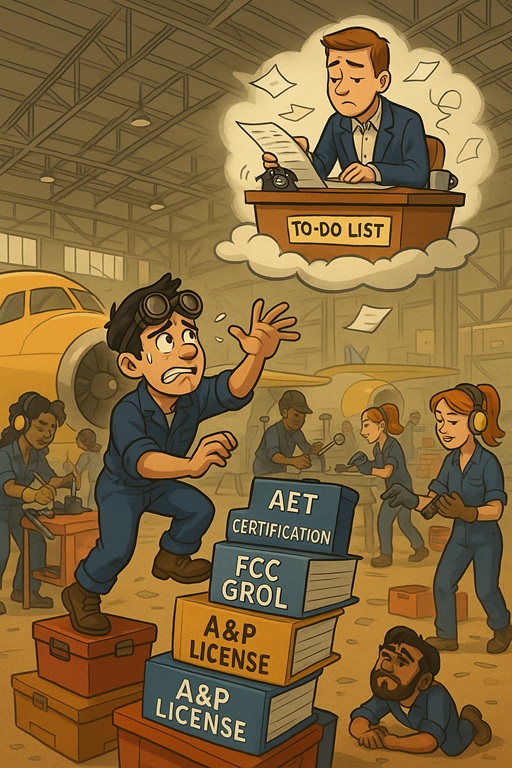
For any aviation professional, a solid foundation is built upon recognized certifications and rigorous training. Credentials such as the Aircraft Electronics Technician (AET) certification, FAA Airframe & Powerplant (A&P) certification, and FCC General Radiotelephone Operator License (GROL) are not merely formalities; they are prerequisites for credibility and advancement in the field. AETs and A&Ps must not only maintain up-to-date technical skills but also demonstrate a commitment to ongoing professional development. Mastery of regulatory requirements, avionics systems, and safety protocols distinguishes those prepared for further responsibility.
At this stage, the aviation maintenance technician is akin to a craftsman, honing expertise through real-world problem-solving and meticulous attention to detail. Yet, as any experienced professional knows, technical prowess alone seldom propels one into the management echelon. The question then becomes: how does one leverage these certifications and experiences to rise above the crowded runway of candidates vying for leadership?
Bridging the Gap: Education, Experience, and Soft Skills
The pathway to management in aviation maintenance requires more than just certifications; it necessitates a strategic investment in both formal education and practical leadership experiences. For many technicians, pursuing additional academic credentials—such as degrees in aviation management or business administration—can provide the theoretical framework necessary for supervisory roles. Aviation maintenance programs increasingly emphasize not only technical proficiency but also courses in organizational behavior, logistics, and systems management.
Simultaneously, on-the-job experience in supervisory functions, such as lead technician or project coordinator, offers invaluable exposure to team dynamics, scheduling, and conflict resolution. These experiences serve as a proving ground where technicians can demonstrate aptitude for leadership under pressure. As one might observe, climbing the aviation career ladder is rarely a straight ascent; it is a calculated series of moves, each requiring deliberate preparation and sometimes, a willingness to weather turbulent conditions. (The path can be more unpredictable than a cross-country flight in bad weather—where adaptability and decision-making become survival tools.)
Advancing Through Specialized Certifications
In an environment where regulatory demands and technology are constantly evolving, additional certifications remain a powerful differentiator. Specialized endorsements such as NCATT Foreign Object Elimination (FOE) or NCATT Radio Communication Systems (RCS) can signal expertise in niche areas, making candidates more attractive for supervisory and managerial posts. For military veterans, leveraging experience through programs such as aviation maintenance training for veterans or using the GI Bill to attain advanced certifications can be instrumental in transitioning to civilian management roles.
While it is tempting to believe that a single credential can serve as a golden ticket, the reality is that upward mobility in aviation maintenance is rooted in a continuous commitment to learning. The industry values those who not only attain but maintain high standards of knowledge and practice, as this assures employers of ongoing competency in a rapidly changing landscape.
The Critical Role of Leadership and Communication
Technical mastery, while foundational, must be complemented by leadership, communication, and organizational skills for those aspiring to management. Managers in aviation maintenance are responsible not only for technical outcomes but also for fostering a safety culture, motivating teams, and managing budgets. The transition demands a new perspective: from troubleshooting individual components to optimizing entire systems and processes.
Effective managers must cultivate clear communication, strategic thinking, and the ability to manage both people and resources. In reality, this may require stepping out of the comfort zone of technical work and embracing the ambiguity and complexity that comes with organizational leadership. Sometimes, the most capable technicians discover that managing people can be more challenging than repairing any aircraft system. (It’s in these moments, faced with resistance or apathy, that the would-be manager’s resolve is truly tested.) Leadership is as much about self-awareness as it is about command—recognizing one’s strengths, weaknesses, and the needs of the team.
Opportunities, Challenges, and the Way Forward
The aviation maintenance industry offers robust career progression for those who are proactive about their development. Resources such as aviation maintenance technician training and job search platforms can assist professionals in identifying new opportunities. Yet, it is essential to approach advancement with both ambition and realism. While the allure of managerial roles is strong—promising higher salaries and greater influence—there are inevitable challenges, including increased responsibility, accountability, and at times, bureaucratic inertia. (One might find, as in life, that every new rung on the ladder brings a different view—but also a stiffer wind.)
In sum, the climb from technician to manager in aviation is not a solitary endeavor but a multifaceted process. It requires technical excellence, continuous learning, targeted certifications, and, crucially, the development of leadership and interpersonal skills. The journey is demanding, yet for those who persevere, it offers the chance to shape not only their own careers but also the future of aviation maintenance.