

In today’s competitive aviation sector, employers continually weigh the relative value of certifications versus hands-on experience when making hiring decisions. The debate is not unique to aviation but is particularly poignant in fields requiring both technical mastery and regulatory compliance. This essay explores what employers prioritize between industry certifications such as the Aircraft Electronics Technician (AET) certification, the FAA Airframe & Powerplant (A&P) certification, and FCC General Radiotelephone Operator License (GROL), versus practical, real-world experience. By critically examining industry trends, employer preferences, and the strategic utility of each, this analysis provides nuanced guidance for aviation professionals aiming to maximize career advancement.
The Value of Certifications in Aviation
Certifications serve as standardized benchmarks, signaling a candidate’s mastery of foundational knowledge and regulatory compliance. For instance, the AET certification and FAA A&P certification are widely recognized credentials, demonstrating a comprehensive grasp of avionics or aircraft mechanical systems, respectively. These certifications ensure that the holder meets or exceeds industry norms and is qualified to perform critical maintenance tasks. In a world driven by rules and checklists, employers view these certifications as risk mitigation tools. Not only do they verify technical knowledge, but they also offer evidence of a commitment to continuous professional development.
Moreover, certifications open doors to career advancement and specialization. For example, the FCC GROL credential is often a prerequisite for advanced roles in avionics. Employers recognize that certified individuals can seamlessly transition into complex projects without extensive retraining. This strategic alignment is critical, especially as aviation technology evolves rapidly, demanding up-to-date technical acumen. In moments of crisis—think of the hurried tempo of a maintenance hangar or the relentless drive of an urgent AOG (Aircraft on Ground) scenario—employers often favor those who hold the appropriate certifications, knowing these individuals can be trusted to “get it right the first time.”
The Weight of Experience
Despite the value of certifications, experience remains a powerful differentiator. Employers often seek candidates who possess a deep reservoir of real-world problem-solving skills—knowledge that is honed only through time spent working on aircraft, troubleshooting failures, and adapting to unpredictable operational demands. When employers browse applications or review resumes on aviation job boards, they frequently filter for candidates with substantial aviation maintenance technician training or prior tenure in complex environments.
Experienced professionals have likely faced high-pressure situations that test not just their technical knowledge, but their adaptability and judgment. This intangible asset—call it intuition, or simply “the edge”—is cultivated only by repeated exposure to real work scenarios. In this respect, experience can serve as a proxy for both reliability and leadership potential. It’s one thing to understand how to replace a faulty transponder; it’s another to do so efficiently at midnight on a remote runway, under the press of time.
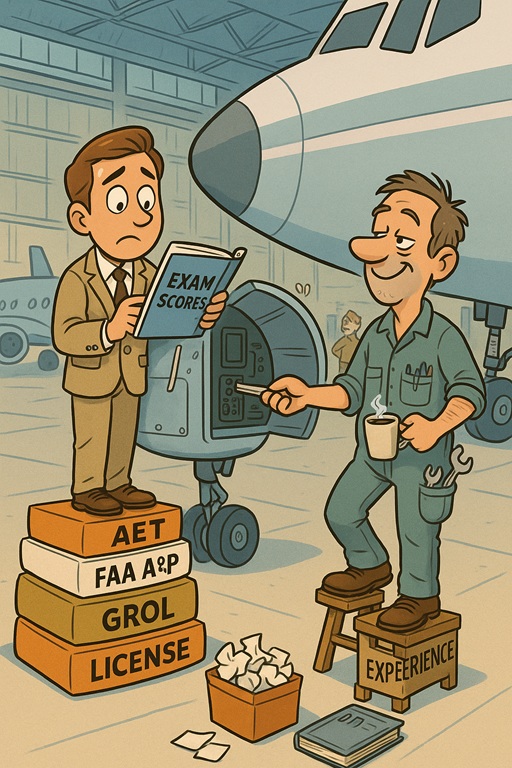
Sometimes, the stories are more important than the numbers. A candidate who can recount a time they diagnosed a critical system fault that stumped the rest of the team can often outshine the candidate with a wall full of certificates but no tales from the field. Employers know this instinctively. In truth, a resume without hands-on experience can look like an instruction manual for a plane that’s never flown.
Integrating Certifications and Experience
The most desirable aviation professionals are those who effectively blend both certification and experience. Employers often look for well-rounded candidates who have, for example, completed A&P mechanic license training and demonstrated their ability to apply these skills in challenging environments. Such individuals are equipped not only with technical knowledge but with a proven track record of reliable performance. In a sense, certifications provide the “what,” while experience supplies the “how” and the “why.”
For those new to aviation or transitioning from military roles, structured certifications offer a reliable entry point. Pathways such as aviation training for military veterans help bridge the gap between military experience and civilian regulatory requirements, streamlining the credentialing process for those with substantial but non-civilian experience.
There’s a stark lesson here: relying solely on one at the expense of the other risks stagnation. A certification without experience may suggest knowledge without application; experience without certification may suggest practice unanchored by current standards.
Employer Preferences and Industry Trends
Industry surveys and employer feedback consistently indicate that while entry-level positions may prioritize certifications, advanced and supervisory roles demand a synthesis of both. In fields like avionics, possessing an AET certification is often essential, but employers still probe for stories of troubleshooting, leadership, and innovation on the job. In practice, employers utilize certification as an initial screening tool, but it is the demonstration of hands-on experience that frequently decides the final offer.
At times, the industry’s relentless pace and unforgiving standards mean that “good enough” is never good enough. The candidates who rise above are those who have earned their scars on the job while amassing an arsenal of credentials.
Conclusion
Ultimately, aviation employers do not view certifications and experience as mutually exclusive. Instead, they seek candidates who can demonstrate both credentialed expertise and real-world capability. As technology, regulations, and industry expectations evolve, the interplay between certifications and experience will only become more critical. For aviation professionals, the optimal strategy is clear: pursue recognized certifications to establish credibility, and seek opportunities to build diverse, hands-on experience to stand out in an ever-competitive market. If you’re considering your next step, consider not only how to register for NCATT AET, GROL, or A&P, but how to turn those credentials into stories worth telling.